
Source: Photo by CHUTTERSNAP on Unsplash
Green building certification has traditionally focused on a structure’s individual efficiency. That narrow focus is shifting. Increased urban density and climate change highlight the close relationship between buildings and their surroundings.
Seismic activity, stormwater runoff and urban heat all travel beyond a building’s footprint. Buildings that can measure and minimize their impact on surrounding infrastructure are setting a new standard for true sustainability.
What Aspects Should Green Buildings Measure?
A building’s dynamic impact on surrounding infrastructure starts with reliable construction measurement across three distinct areas:
- Seismic impact
- On-site stormwater management
- Urban heat island management
How Can Seismic Activity Impact Surrounding Infrastructure?
Buildings with poor seismic resilience can damage surrounding infrastructure. The Federal Emergency Management Agency updated its estimates for earthquake losses in 2026, finding that earthquakes cost the United Statesnearly $16 billion annually. Testing for seismic resistance can help fortify green buildings to reduce losses.
How to Measure Seismic Resilience
Contractors and engineers can use seismic analysis and vibration testing to understand how a building may respond to earthquake-related forces. Shock response spectra (SRS) testing can help teams evaluate how structures and materials respond to sudden shock or vibration events, offering insight into how seismic forces may affect building performance.
Peak particle velocity (PPV) is another key metric that measures the maximum speed of ground particles during a seismic event. This measurement is a direct indicator of vibration intensity transmitted outward to neighboring structures. Together, these measurements help engineers understand how the building responds to seismic input and how much vibration may transmit outward.
How to Minimize Seismic Impact on Surrounding Infrastructure
Two strategies can reduce a building’s seismic footprint:
- Specify mass timber and lightweight structural systems: These systems can produce lower seismic base shear forces than reinforced concrete systems. Timber and lightweight structures can relieve stress on the surrounding ground and foundations during an earthquake.
- Integrate seismic isolation systems: Systems with recycled tire rubber compounds, verified through construction material testing, can reduce a structure’s seismic response and its potential to collapse or shed debris that damages neighboring buildings.
How Does On-Site Stormwater Management Impact Surrounding Infrastructure?
Without on-site stormwater management, new development can strain shared stormwater infrastructure. According to the American Society of Civil Engineers (2025), the 20-year capital improvement needed for stormwater systems nearly quintupled from 2012 to 2022. This jump is partly due to runoff from new construction, placing pressure on the shared systems.
How to Measure Stormwater Runoff Impact
Contractors and engineers rely on a few key methods to quantify a site’s runoff before and after development:
- Infiltrometer testing: This method measures how quickly soil absorbs water, determining how much rainfall will flow off-site.
- Runoff coefficient and curve number calculation: This calculation gives a concrete figure for how much stormwater a developed site generates. It’s the same methodologyLEED’s Rainwater Management Credit requires for compliance.
- Hydrological modeling: This process simulates how a site handles different storms, giving teams proof that their runoff management meets certification requirements.
How to Minimize Stormwater Runoff
Two strategies can reduce runoff at the source:
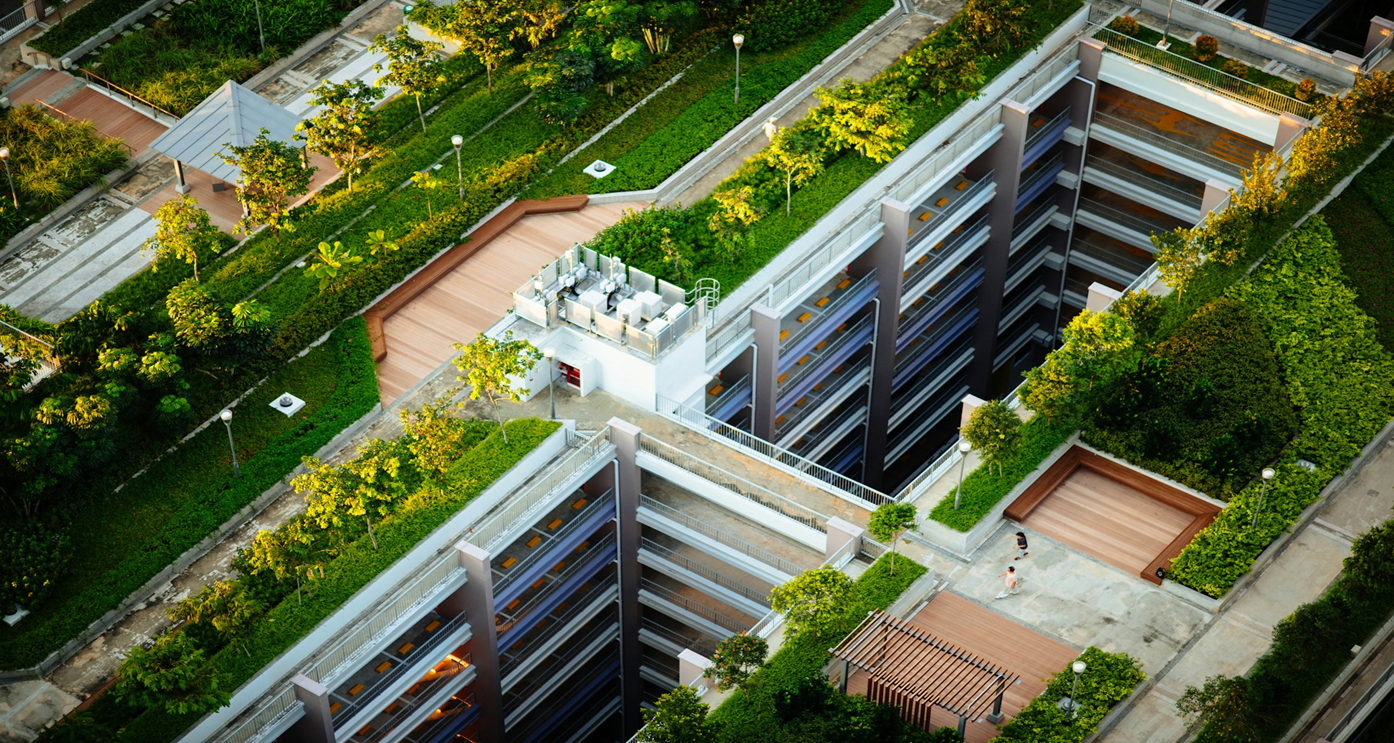
- Install green roofs to intercept rainfall: Green roofs absorb rainfall before it reaches the ground, reducing runoff volume and velocity.
- Specify permeable paving: Permeable paving lowers both the volume and speed of runoff that the surrounding infrastructure must absorb.
How Does the Urban Heat Island Effect Impact Surrounding Infrastructure?
Extreme heat can shorten the life expectancy of road pavements near a development. The Fifth National Climate Assessment (2023) projects that transportation infrastructure could faceannual losses between $9.8 billion and $24.3 billion for roads by 2090.
How to Measure Urban Heat Island Impact
Two complementary methods reveal how much heat a site radiates into its surroundings:
- Solar Reflectance Index testing: This method quantifies how much solar energy a surface reflects and absorbs. It’s the exact metricLEED’s Heat Island Reduction Credit requires for roofing and hardscape materials.
- Thermal infrared imaging and satellite remote sensing: Infrared cameras and satellite data can map land surface temperature across a project area, revealing how a building contributes to warming beyond its own lot lines.
How to Minimize Urban Heat Island Impact
Two design choices can meaningfully lower a site’s contribution to surrounding heat:
- Specify high-SRI roofing and hardscape materials: Cool roofs and reflective paving materials with documented Solar Reflectance Index values reduce the amount of heat a building radiates.
- Integrate green roofs and an urban tree canopy: Vegetation cools surrounding infrastructure by shading hard surfaces from direct solar radiation and releasing moisture through evapotranspiration, thereby lowering ambient air temperature.
Measurement and minimization are not simply technical checkboxes. They mark the difference between green building as a genuine commitment and green building as a marketing label. Seismic shock, stormwater runoff and urban heat rarely stay within a building’s footprint. They travel through soil, through shared drainage systems, through the air above neighboring rooftops.
Measuring these impacts makes that transmission visible and quantifiable. Minimizing them is what makes a building genuinely green rather than simply efficient in isolation.